

Fertility Investigations, Ovulation Induction & Preconception Counselling
Evidence-based fertility investigations for couples experiencing delayed conception or recurrent miscarriage, combining ovarian reserve profiling, tubal patency assessment, ultrasound-monitored ovulation induction, and preconception medical optimisation.
Your questions, answered simply
Tap a topic to read more.
Structured Diagnostic Workup for Delayed Conception & Subfertility
We recommend a structured fertility evaluation if a couple has not conceived after 12 months of regular unprotected intercourse, or after 6 months if the female partner is aged 35 years or older, or immediately if there is a known history of irregular cycles, endometriosis, pelvic inflammatory disease, or previous ectopic pregnancy.
Rather than ordering unfocused tests, Dr Tebo Rasenyai follows a logical diagnostic pathway that evaluates the three essential pillars of natural conception: regular ovulation and ovarian reserve, a healthy uterine cavity and patent fallopian tubes, and normal semen parameters.
- Ovulatory & Endocrine Profiling: Cycle day 2–3 basal hormones, Anti-Müllerian Hormone (AMH), thyroid function, prolactin, and mid-luteal progesterone confirmation of ovulation.
- Uterine & Tubal Evaluation: High-resolution transvaginal ultrasound, Hysterosalpingography (HSG) or diagnostic laparoscopy and dye perturbation (chromopertubation) to confirm fallopian tube patency.
- Male Factor Assessment: Coordination of accredited laboratory semen analysis for the male partner.
Ovarian Reserve Profiling, Tubal Patency & Male Partner Evaluation
Because male factor subfertility contributes to approximately 40% of couple subfertility, we encourage both partners to attend the initial fertility consultation where possible. Evaluating both partners simultaneously prevents months of delayed diagnosis.
When structural barriers to implantation or tubal transport are identified — such as submucosal fibroids, endometrial polyps, intrauterine adhesions, hydrosalpinx, or endometriosis — Dr Rasenyai performs minimally invasive hysteroscopic or laparoscopic surgery at Clinix Victoria Private Hospital to optimise reproductive anatomy.
Monitored Ovulation Induction & Follicular Tracking Ultrasound
For women with anovulatory cycles (such as PCOS or hypothalamic ovulatory dysfunction) and patent fallopian tubes, monitored oral ovulation induction (using letrozole or clomiphene citrate protocols) is a safe, effective first-line fertility treatment.
Dr Rasenyai performs serial transvaginal follicular tracking ultrasounds around cycle days 10 to 14 to measure dominant follicle growth and endometrial trilaminar thickness, advising couples on the precise fertile window for timed intercourse or triggering ovulation when the lead follicle reaches maturity.
Preconception Health Optimisation for Women with Chronic Medical Conditions
A dedicated preconception consultation is invaluable for women planning a pregnancy who live with chronic hypertension, diabetes mellitus, epilepsy, thyroid disease, autoimmune conditions, or a history of previous adverse pregnancy outcomes.
During a preconception visit, we review and transition any teratogenic chronic medications to pregnancy-safe alternatives, optimise HbA1c and blood pressure control, verify rubella immunity, and initiate appropriate folic acid dosage before conception occurs.
Ready when you are.
All medical aids welcome, with no co-payments on consultations.
Patients often ask
When should a couple book a fertility consultation with a gynaecologist?
If the woman is under 35 with regular periods, book an evaluation after 12 months of trying to conceive. If the woman is 35 or older, book after 6 months. If you have irregular or absent periods, known PCOS, endometriosis, fibroids, or a history of two or more miscarriages, you should book an assessment straight away without waiting.
What should we bring to our first fertility appointment?
Please bring a record of your menstrual cycle dates over the last 3 to 6 months, any previous hormone blood tests, previous pelvic ultrasound or HSG X-ray reports, surgical notes from any prior pelvic operations, and any previous semen analysis results.
What happens during a follicular tracking ultrasound scan?
A follicular tracking scan is a brief, gentle transvaginal ultrasound performed around mid-cycle (typically days 10 to 14) with an empty bladder. It measures the size of the developing ovarian follicle(s) in millimetres and checks the thickness of the uterine lining so we can pinpoint ovulation accurately.
Related care

PCOS & Period Problems
Answers and a clear plan for irregular, heavy or missed periods.
Learn more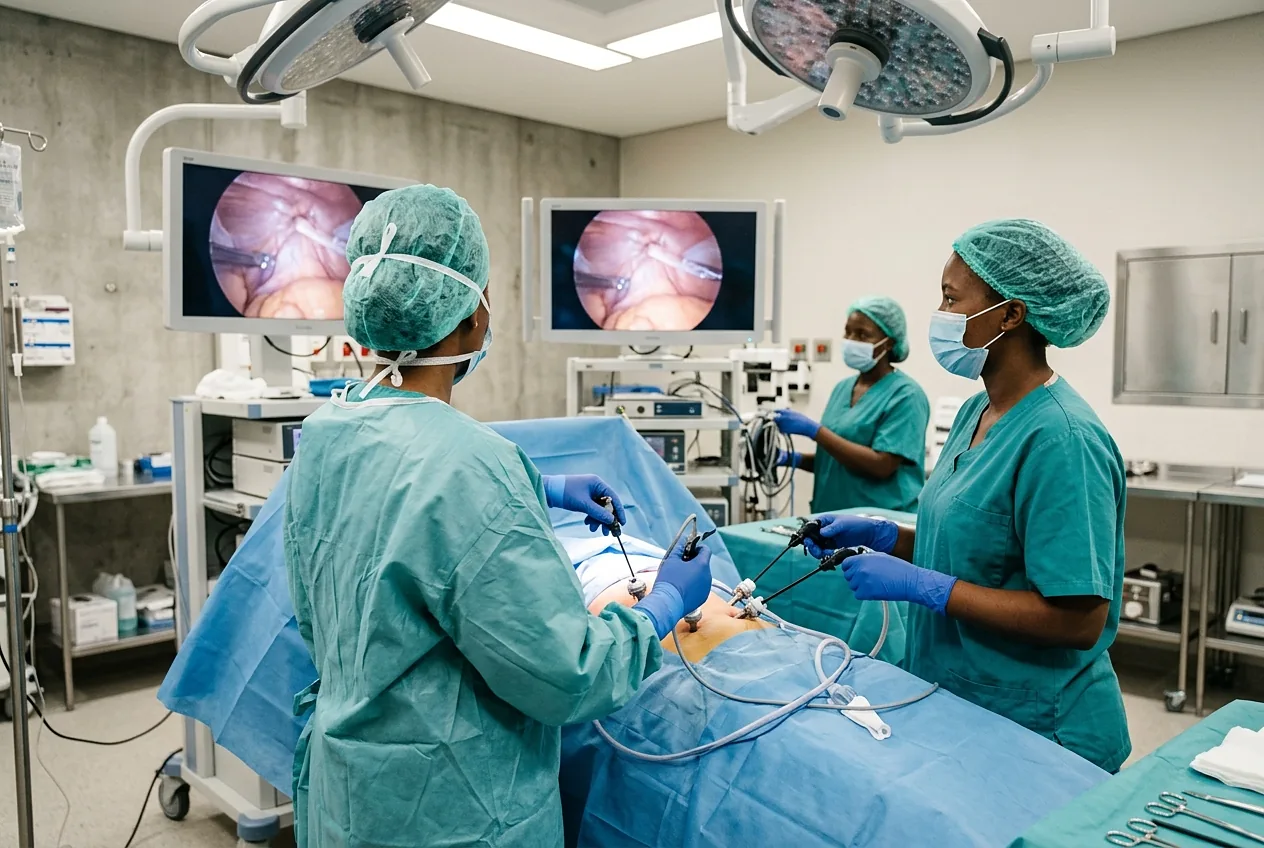
Keyhole (Laparoscopic) Surgery
Smaller incisions, less pain and a faster return home for cysts, fibroids and more.
Learn more
Pregnancy & Maternity Care
Scans, check-ups and a birth plan made with you, from 8 weeks to your baby’s first cuddle.
Learn moreLet’s talk about your care
Consultations take place in our rooms at Clinix Victoria Private Hospital, First Floor, Suite D, Room 2, Mahikeng.
Request an appointment
Fill this in and we’ll open a ready-to-send WhatsApp message to our reception. We usually reply within working hours.